Brews by Country

Monday, 11 April 2016

Hazelnut Brownie (6.3%) - Batemans Brewery, Lincolnshire, England

I might have something approaching an oversupply of beers from my new Spanish region of Galicia developing, but since Christmas I've had something different put aside for a special occasion. That something different was a unique English ale by Batemans Brewery that my girlfriend had bestowed on me, and that special occasion was Friday.

The label on Hazelnut Brownie, as with the other beers in Batemans' Sovereign range, has undergone a bit of a rebranding with a contemporary typographic look in favour of the more homely, rustic appearance that it used to sport on its beer pumps. Batemans is keen to highlight its long heritage, though, with its big wax stamp and the year it was founded, 1874, proudly displayed on the front. 

Lincolnshire within England
No sooner is the cap cracked off than the beer's lusciously fragrant aroma starts permeating the space around you without even needing to edge your nose closer to it. I shoved my nose down the bottle neck for a bigger hit anyway, sending my brain into a chocolatey frenzy before the stuff had even left the bottle. Once it had been given a swill around my glass, rich, creamy aromas of chocolate and sweet malts were diffusing apace. It was clear at this point that this would be no subtle interpretation of a hazelnut brownie.

It pours a gorgeous dark mahogany, with a generous coffee-coloured head that gathers and dissipates cleanly. If you've noticed that this is the only blog post of mine where that hasn't been captured in a photo then you'd be right: my chocolate-scrambled brain forced me to dive in straight away before I could.

Soon after doing so my cakehole was filled with the most ridiculously uncanny resemblance to a brownie I'd ever sampled from a beer glass. Sweet chocolate was there in abundance along with a touch of cinnamon spice and a distinct hazelnut finish that was too good to believe it could be true until I went back for more.

While it wouldn't hurt for the body to be a bit fuller, it's certainly as rich and decadent in flavour as it could be and manages to impart a creaminess, I assume from the use of lactose, that could have you believe you'd had it served up with custard, warmed up by the 6.3% ABV.

Quirky, dessert inspired beers are nothing new, but what sets Hazelnut Brownie apart from so many others I've tried is that you don't need to use your imagination to convert those dark roasted malts and reinterpret them as chocolate; this one does all the work for you. Whether this sensation has been achieved solely with the creative use of malt, hops, chocolate and cinnamon I can't say for sure, but who cares? It tastes like what you wanted it to when you picked it up off the shop shelf.

Appearance 4/5
Aroma 5/5
Flavour 5/5
Mouthfeel 3/5
Overall 8.5/10

Head here for Batemans' website  
Head here for a review of Batemans' English B Bock

Tuesday, 5 April 2016

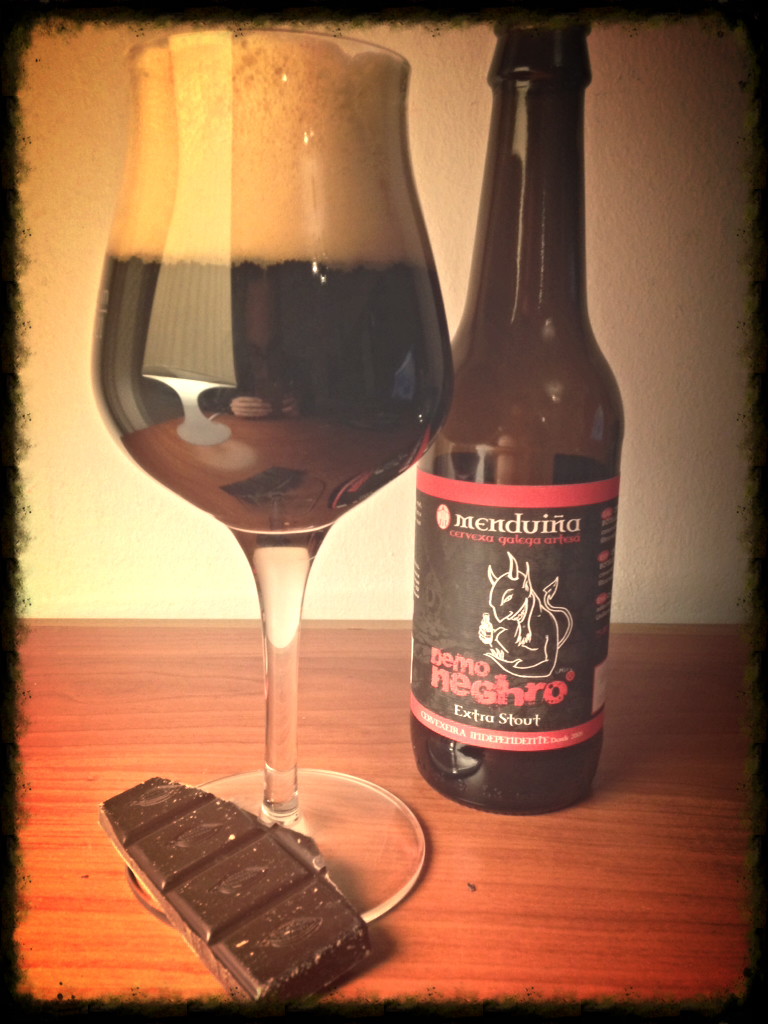
Demo Neghro Extra Stout (6.5%) - Cervexa Menduiña, Galicia, Spain

As we enter April and springtime makes a leisurely and largely hesitant return to Lugo, Spain, I realise seven months into my residency here that I imported my beer-hoarding tendencies with me, having developed a sizeable collection and now not knowing where most of it even came from.

Fancying something to match the current climate, I picked this out. Whereas in this part of the world many of the artisan beer offerings have been established relatively recently, to my surprise it turned out that Menduiña is no newcomer to the craft beer scene. They've been squirting out barrels of cervexa since 2008, which by modern standards practically makes them craft beer veterans.

Hailing from Pontevedra, a coastal town in the region of Galicia, the brewery's aim is to "reclaim a part of the lost culture of our ancestors" by reviving what the ancient dwellers of these lands would have drunk without fear of being labelled barbarians before those poncey wino Romans came along. I very much doubt they would have been drinking 6.5% stout, but this is where the brewery's innovation comes into play.

Pictured on the matt, textured label is the very "Black Devil" that inspires the beer's Galician name, grimacing sardonically over a bottle of the good stuff. Interestingly the pagan Celts knew no Devil before the pesky Romans arrived, so this mischievous character seems to be one influence they were happy to keep. 

The beer pours an luscious jet black with a stunning cushion of coffee-coloured head that leaves a wonderful lacing down the glass. 

On the nose it's impressively fragrant for a stout with aromas of dark chocolate, coffee and a sweetness from the added Galician honey coming through immediately. The smell is so moreish in its own right, in fact, that I almost couldn't bring myself to tear my schnoz away from it to go in for a sip.

But of course I did, and the few glugs I ingested were a silky smooth, full-bodied delight. It has qualities of smoky, woody, dark roasted malts and some herbal hoppy notes that add balance with a bitterness, ending in a dry, nutty finish. Owing to the high ABV, a mellow alcoholic warmth is ever so slightly present.


On the brewery's recommendation I paired this with a few cubes of chocolate negro. This particular chocolate was on the lower end of the bitterness scale at 55% cocoa, and so while the bitterness of the chocolate complimented the roasted characteristics of the beer, at the same time they offset each other to leave the sweeter malty flavours, as well as the more herbal of the hoppy flavours to surface. Whichever way you have it, this is a devilishly good brew.

I have another offering from this brewery lurking in my special, top-secret beer place, so you'll be seeing more from me on them in the near future.
Spanish National Beer Championship 
2015 Bronze award winner


Appearance 5/5
Aroma 5/5
Flavour 4/5
Mouthfeel 4/5
Overall rating 9/10

Menduiña's website: http://www.menduina.eu/

Thursday, 17 March 2016

Burnin' Alive Galician Coast IPA (6%) - Keltius In Peccatum, Galicia, Spain

On an uncharacteristically sunny late winter afternoon in Lugo I was walking a route I take regularly when I noticed that a retail outlet which I'd passed countless times before had its doors open. Highly unassuming from the outside (lacking so much as a sign) my curiosity had led me to peer through its windows on previous occasions, and I was thrilled to see that in amongst a varied selection of wine bottles, there was shelf space devoted to a number of unique-looking beers. It was just a question of accessing them.

Now presented with an open door to a pre- or post-siesta bottle shop, I seized the moment and scampered in with haste. My excitement was soon marred by the discovery that a good number of the beers were out of date, a fact the shopkeeper was keen to highlight and dismiss in the same breath. Eager not to part with 2,50€ for a brew that should have been ingested at least two months before, I inspected my way to an unexpired brew from the Galician town of Ourense and purchased it speedily before leaving.

The label is an eye-catching one, the horned, muscular, skull-faced, red-irised individual holding an electric guitar above his head surrounded by flames making for an interesting choice of design, and fuelling my anxiety to find out what an Ourensano interpretation of a modern-day IPA would resemble. 

My experience began on a positive note as the brew poured a gorgeous amber colour, cloudy in my case as I let the sediment slide its way in to enjoy the party. A tremendous fluffy head gradually took shape, one which left some spectacular lacing down the glass. 

The aroma immediately provided the familiar old scents of juicy, tropical pine, awakening memories of my former IPA-guzzling days which would occur routinely in my UK abode. From the whiff alone, it certainly seemed to be an IPA as I knew it. 

Diving in for a slurp I was equally pleased: a sharp citrus bitterness swooped in to cut through the juicy tropical pine resin, with added herbal, peppery hints. The slight spicy sensation of the peppery notes coupled with an alcoholic warmth might have inspired the name, although I wouldn't describe it as burning alive; it's a pleasant and probably far more enjoyable sensation. 

The mouthfeel is a tad gassy for my liking, creating a light and airy quality that compromises the body. Saying that, the prickle which the carbonation imposes on the tongue coupled with the bitter, spicy hop flavours do prove to work well with the image of the evil tormenter on the label, and impart a character as rocky and rugged as the Galician coast itself. 

Appearance 5/5
Aroma 4/5
Flavour 4/5
Mouthfeel 3/5
Overall 8/10

Wednesday, 24 February 2016

Moura (5.5%) - Cervexa Artesá Aloumiña, Galicia, Spain

During a festival called San Froilán when the good inhabitants of Lugo in Spain go potty for octopus in their thousands over two weeks of October, I was pleased to see a stall belonging to Aloumiña brewery which showcased the three beers in their range, and tried their bitter-style tosta directly from the cask out of a plastic cup. Relieved to get some top-fermented goodness down me, I scraped together whatever euros I had on me and put a bottle away for a rainy day, of which there's no shortage here.

Wondering if I might ever again encounter a beer in Lugo that deviated from the ordinary selection on draught, in a dark corner of a bar one cold and stormy night (we'll say for dramatic effect) I saw one lone customer with a bottle of an Aloumiña beer in his possession, the only indication of this beer's availability behind the bar. I made a curious enquiry and out came a bottle of their blonde beer Loura from the shelf of a hidden fridge, an exbeerience repeatable in many other bars in town. Having opened up a whole new world of possibilities to me I felt like I now belonged to some elite club, one of the select few equipped with the knowledge to access a diverse range of hard-to-get, small-batch craft brews. The secret code phrase was now mine: "What else have you got?" 

What I'd saved for a rainy day and was still yet to sample was the darkest in their range, Moura. In a tremendous twist of fate it wasn't raining today, but I wasn't going to let that stop me. 

The label boasts the use of quality ingredients even down to the local water (what better use for it?) and adding to the beer's local character all the blurb is in the Galician language. Proudly proclaiming itself a "top-fermented, ale-style" unfiltered, unpasteurised and bottle-conditioned "living" beer, this couldn't be more different from the dead, mass-produced beer more commonly enjoyed here.

As if that wasn't enough, Moura pours the deepest, darkest chestnut brown a beer could be, with a coffee-coloured head that dissipates slowly to leave the odd small patch of lacing.

The aroma is of a smoky, woody quality with distinct hints of roasted chestnuts (another thing Galicians are particularly fond of in the winter months) and fainter hints of licorice. After a glug your mouth is awash with a medium-bodied mouthful of roasted and caramel malts that develop into a delightful dry, toasted, nutty finish. 

It becomes clear that what we have here is a 21st century all-Galician porter, a well-established beer style that Aloumiña have picked up and made their own with bags of character that call to mind a Galician winter's day. This is a bittersweet, nutty, Mourish delight.

Appearance 4/5
Aroma 4/5
Flavour 4.5/5
Mouthfeel 4/5
Overall rating 8/10


Tuesday, 16 February 2016

An Emotional, Gastronomic Exbeerience: Red Courtesy (5.5%) - Valencia, Spain

Not long has passed since I vowed to focus on small-batch brews from my new region of North West Spain but alarmed to see the expiration of one of my beers from an opposite end of the country was looming I felt duty-bound swoop in and save it from oblivion. Then again, I probably would have drunk it post-oblivion anyway.

Having established myself as an appreciator of all (well, most) things fermented with hops and malts at my new place of work, I was gifted this elegant little number by my colleagues for Christmas. The brewers of this gourmet beauty seem elusive folk, remaining something of a mystery until some light research reveals them as a distributor called Hidden Ice (hidden indeed) who sell several kinds of beverages, the only beery one among them this (although I'm told they have new brews in the pipeline which I'll be poised to seize the moment they're released). Supposedly inspired by elements of Japanese culture, the unique, corked, ceramic-like bottle is a wonder to behold and, despite not being the most gifted uncorker, I was eager to pop my way in.

My caution during the uncorking process was futile: within moments the cork vanished from sight in a puff of smoke and my lap was coated in a thick, gloopy white foam which, rest assured, had come from the bottle. 

Eventually a hazy orange liquid pushed past the froth and filled my glass, now with only a trace of head to be seen. With allspice, dried flower orange blossom and Buddha's hand (a little-known fruit that resembles a lemon-octopus hybrid) among the list of ingredients, it's no wonder you get a delightful noseful of fruity, floral and zesty aromas on your way in. 

The flavour shares the same complexity, the added botanicals imparting spicy, peppery and zesty citrus notes with all the floral character of a Japanese garden, all coming at you harmoniously in a gorgeous, full-bodied liquid, full of flavour and yet remaining elegant. 

But the fun doesn't end here. "The serving ritual takes Red Courtesy down different sensory paths" claims the website: in my case it was the sensation of a soggy pair of jeans, but this isn't exactly what the brewers have in mind. Despite my impression of this beer being highly positive as it is, to experience the beer's qualities at their best we're encouraged to engage in a distinctive serving ritual, taking it "where no beer has ever gone before" (and not just my lap). 


If you thought a bespectacled, bearded, checked-shirted man holding his beer glass up to the light prior to swirling it around and introducing his nose past the rim for some sniffing action before taking a swig was an elaborate procedure, you ain't seen nothing yet. Depending on which of this brew's charming characteristics you fancy enhancing, you can opt for the spicy, citric or floral "orientations", pouring a small serving of beer through a strainer containing more of the botanical ingredients provided in the kit, into a chalice. Yes, that's right; a chalice. No casual drinking experience is this, then, but a ceremonial affair intended to transport you to Takama-ga-hara or wherever, although it's hard to imagine a situation in which you could earnestly present this kit to your dinner guests and not have them falling about with laughter.

Do I detect a smattering of gimmickry at play? Absolutely, but it's a gimmick I'm happy to take seriously; after all, Red Courtesy grabs your attention as soon as you set eyes on its graceful, slender, black, corked receptacle on the shop shelf, and that's why you'd pick it up in the first place. Fortunately the appeal extends far beyond this as the brew lurking inside is of quality and delicious. So roll with it, remove the muddiness from your mind, stop seeing the forest and start to see the trees... or something.

Appearance 5/5
Aroma 4/5
Mouthfeel 4/5
Flavour 5/5
Overall Rating: 9/10

Monday, 1 February 2016

The Ibeerian Peninsula: Estrella Galicia

Happy New Beer! \~/


A new year has dawned (it's fair to say I'm a bit late on that one) and it's time for me to dust the cobwebs off my keyboard and continue my valiant efforts to sample as many hopped, yeast-fermented malt beverages as I can for the benefit of humankind.

Previously conducting my precious research from a little corner of south east England, I've now upped sticks to a mystical territory known as Galicia in north west Spain. Such a move would have always lead to numerous changes to my lifestyle, but the one I was most concerned about, of course, was the selection and availability of beer. 

Since I first stepped foot on Galicia's astoundingly fertile green and pleasant land, it was clear that my drinking habits would have to adapt substantially to the local drinking culture. For a start, beer to a Galician normally means one thing: Estrella Galicia by Hijos de Rivera brewery, a 110-year-old family-owned brewery which squirts out 100 million barrels a year and has all but monopolised beer consumption in this area. There isn't a bar, cafe or restaurant in this part of Spain that doesn't serve it (bar the odd trend-bucker), and if you're after an alternative then more often than not your choice will consist of another offering by the same brewery. 

So for a start, my days of entering a pub and standing at the bar, quietly and agonisingly perusing the labels on the beer fonts before deciding which local or guest ale I should order were decidedly over. "Una caña" (referring to the measure of a small draught) is all I had to ask for now, and soon after a 250ml glass (give or take) of a sparkling, golden, foamy Estrella Galicia would be plonked down in front of me by default most of the time. 

Indeed, when you order a beer in Spain there's no need to even mention beer: ask for a cerveza (or a cervexa in Galicia's local lingo) and you'll be asked how much of it you want, not which kind you want. If a caña doesn't do it for you then a media will get you 330ml, a sorry amount by UK standards but, believe it or not, as much as most Spaniards care to go for at a time. In fact, if a different measure is to be had then it's usually even less than a caña, a 200ml quinto. My British sensibilities were highly affected by these unthinkable measures at first: who orders less than a pint, and who orders even less than less than a pint? It soon occurred to me, though, that a caña fits the Spanish pace of life perfectly, especially when the locals happily sip away from lunchtime and bars don't start to close until 3am (sometimes with you still in them).

What of Estrella Galicia, then? It's a lager (no surprises there) and so shares the same characteristics that all lagers aim for, best described in terms of sensation rather than flavour: clean and refreshing, even if the climate in this corner of Green Spain doesn't always call for it.


A caña with a tapa (free bar snack) in Lugo, Galicia

Prejudices against mass-produced lager aside, after five months of this as my go-to beverage (if you can't beat them, join them) I could almost say I've found it a useful exercise - shock horror - in fine-tuning the taste buds in a desperate attempt to pick up on whatever vague hints of flavour I can, and if the monotony of constant lager consumption hasn't caused me to fall victim to delusional taste hallucinations, I'd go as far as to say a distinctive malty nuttiness is present. It is, I swear it is.

Encouragingly, Hijos de Rivera have a few more ambitious offerings under their 1906 label for those who fancy dipping their toes in something with a bit more character.


1906 Reserva Especial (6.5%) is a full-bodied strong lager with a primarily bitter flavour from the Nugget hops, a slight pepperiness and a hint of toasted malts.

1906 Red Vintage (8%) is malty with a bitterness that seeks to counteract a slight spirity alcoholic flavour coming from the high ABV. A gentle burn is present but it remains drinkable on the whole. 


1906 Black Coupage (7.2%) is the black sheep of the family which is intended to be served at the higher temperature of 6-8 degrees to bring out the flavours of the four malts and two hops. With roasted coffee, chocolate and licorice flavours you'd expect from a porter but almost all the crispness of a lager, Black pushes the boat out even as a bottom-fermented beer, and although super dark lagers have always seemed a bit of a contradiction to me I must give this one an A for effort. Not that it needs it from me, because all of the above beers have already bagged themselves tons of awards (although most of them have gone to the other three).


Albeit Hijos de Rivera's bevvies are the most popular beers in Galicia, I've been relieved and excited to discover a significant minority of local and regional small-batch offerings along the way that are gradually making their presence felt here. These will be my focus from now on, but for now by way of a preview I leave you with my ramblings on a Galician pale ale called Loura by Aloumiña brewery in Lugo. Salud! \~/


Monday, 23 November 2015

The Brewhive Range - Edinburgh, Scotland

After a fairly lengthy hiatus (in writing, that is; not beering) which had been causing people to lose sleep throughout the beerosphere, I'm back with a review of a different sort (sighs of relief all round). As it happens, I have a very good reason for this hiatus which I'll go into in agonising detail in a future post, but for now, on with our selection for today...

On a balmy August morning I was fortunate enough to have a fairly weighty package turn up on my doorstep courtesy of Brewhive, a newly launched, online-only beer distributor based in Edinburgh, Scotland. "Hop inside!" it instructed me to do on the lid, and I hopped my way into the box like an excitable bunny opening a box of pellets. Hop pellets.


After releasing the beers from their hive (well, five beers and a cider, I was surprised to see) it soon becomes clear that Brewhive have taken a more utilitarian than decorative approach, their labels reserving more space for ingredients and tasting notes than imagery for imagery's sake. Pushing to highlight the beer's characteristics on the front of the label in this way, it seems as if someone with an OCD at Brewhive HQ might be trying a bit too hard make this an educational experience which the drinker will either appreciate or find a tad excessive.  

Saying that, it's clear from their website that their aim is to appeal to fine diners and wine drinkers, showing them that beer in all its varieties has at least as much to offer in the way of complexity as wine, a sentiment I wholeheartedly agree with. It does raise the question, though, of whether the brews themselves live up to the description they're given (and before we get there, I have to warn you of a highly questionable choice of glassware which was sadly unavoidable at the time).

The role of Blonde Brew is filled by the German Magnum Lager (4%), "magnum" having nothing to do with a frozen treat on a stick nor a firearm, but referring to the hop used which is known for the floral and fruity characteristics it normally imparts. The label describes its bittering qualities as subtle, a monumental understatement in this case, with a chronic lack of depth and not to mention a level of carbonation unthinkably low for a lager. With the lager style being the most popular globally and being in the grip of the big corporate giants, any small-batch interpretation needs something to set itself apart and differentiate itself from the cheap and cheerful, mainstream, mass produced stuff so accessible to us all, and if Blonde Brew manages to pull that off then I'm afraid it does so for entirely the wrong reasons. 

How does the Pale Brew fare? English Endeavour I.P.A. (4%) is an easy going IPA with a bitter citrus aftertaste and hints of lime and grapefruit as promised from the Endeavour hops. This bottle was fairly low on the carbonation too, but for a top-fermented brew I can forgive that. Don't go expecting the brash, in-your-face flavours of an American IPA; this is its low-key, understated, slightly annoyingly over-polite English cousin: a fresh, sessionable sipper for a hot summer's day. With current trends going in favour of much bolder flavoured IPA's, it seems that Brewhive are making a dogged attempt at reclaiming the title for their mission of "teasing the taste buds rather than annihilating them". But is it the job of the 21st century India Pale Ale to tease the taste buds? I dare say it's not. 

Seemingly hoping to leave no taste uncatered for, Brewhive have thrown its Apple Irish Cider (5%) into the mix. Cider, for anyone not sure about this, is not beer. I haven't drunk cider out of choice since my palate matured past the awkward beer-averse phase most of us go through in our teen years, but I'll never shy away from one if the circumstances call for it. With a lovely pinkish colour, it's attractive in the glass. It has a good level of carbonation with a sweet flavour and dry mouthfeel, without the stale, farmy aftertaste you get from some ciders. I don't know if it says more about the Cider Brew or the previous two beers, but this came out easily as my favourite so far.

Not for long, though. The Dark Brew, Chocolate Malt Porter (4.1%) is described in words that always send my taste buds into a salivating frenzy. Bitter roasted malts come through in abundance, along with chocolate, coffee and treacle flavours, some of which aren't mentioned on the label, but all of which are welcome components in anything with the words chocolate, malt or porter. Liquorice was faintly present; vanilla I can't say I picked up on, not that it matters unless that was something on the label that got you particularly excited. Either way, its rich flavours wash over the tongue in a gloriously smooth and full bodied liquid, ending with a medium dry finish.
The back of the label recommends trying this out with cheddar, and with a block in my fridge ready to roar I’d be foolish to let such an opportunity pass me by, let alone to see this bottle’s lifespan end without having been given the chance to dance around my mouth in harmony with one of its closest friends. The saltiness of the cheddar balances the bitterness of the roasted malts to enhance Dark Brew's chocolatey qualities as well as the creaminess of the cheese. The Dark Brew's mellow character makes it very quaffable and ideal for a nice indulgent treat, whether amped up with a block of cheddar or not.

Overall, while I'm grateful to Brewhive for introducing me to their range, I would suggest their beers belong less alongside wine drinkers and their dinner and more in gift selection boxes. Although the brewers seem to have made the conscious effort to go for subtle flavours, in doing so they're hardly fulfilling the aim of showcasing the complexities that hops and malts have to offer, and in my view are needlessly worried about overpowering accompanying dishes. Not only can rich, powerfully hopped beers be matched with food superbly, but let's face it, there'll be more chance of punters quietly knocking these back with a bowl of cheesy puffs than a plate of seared scallops.

You'll find more information on Brewhive's beers (and cider) at http://www.beerhive.com.