Brews by Country

Showing posts with label spicy. Show all posts

Saturday, 3 April 2021

Saucery Session IPA (3.9%) - Magic Rock Brewing, West Yorkshire, England

You could be forgiven for wondering why things have been so quiet around here lately when planet Earth has been shut down and I should, if anything, have more time to dedicate to the exploration of beer. The odd fact of the matter is that the start of the pandemic coincided with a New Years resolution to experimentally forgo alcohol from Sunday to Thursday, leading to less of an inclination towards written drinking practices on the two remaining days of the week.

But during a recent bout of compulsory self-isolation following a flight of utmost importance, I found myself suddenly being the recipient of a generous beery windfall, and the conditions were perfect for dusting off the ol' tasting notepad (opening Blogger) and reporting on my experience.

The first brew I ever had by Magic Rock Brewing was their very nice 6% Surreal Stout - from the other end of the spectrum from this 3.9% IPA, but my promising encounter had me looking forward to seeing what this one was about. 

Saucery Session IPA pours a hazy straw colour with a fizzly head. The aroma gave way to enticingly fresh tropical and citrus aromas, sweet mango and passion fruit meeting zesty lemons.

Each swig brought with it oodles of juicy tropical and citrus flavours, accompanied by some spicy and peppery bitter notes that lingered through the dry finish. It's exactly the kind of brew that is perfect for sipping on at any time of day, whether alone or in the company of friends* (*according to the rules wherever you are at this point in time, of course). 

At a mere 3.9% (which I have to admit is an ABV that I usually sniff at - no more!) Magic Rock have managed to produce beer that's as impressively flavourful as it is sessionable. An act of saucery indeed!

Rating ★★★★★★★★☆☆

🍻Cheers us on Facebook🍻


Magic Rock Brewing
Website here 
Facebook page here


Where to buy
£1.80 at Tesco


Monday, 1 April 2019

Breakfast Club (6.9%) - Vocation Brewery & Yeastie Boys collaboration

In a world where it's normally frowned upon to reach for a beer before midday (except at airports, you might have noticed) the so-called "breakfast stout", which also ironically never tends to be particularly low in alcohol, has to be one of the naughtier styles out there. Feeling naughty, I grabbed a can of this Pommie-Kiwi collab brew and decided to dive in.

The first thing I noticed before anything else wasn't the design on the can, but the size of it. At 440ml it bucks the trend of small-batch indulgences being presented in smaller measures, which is just as well, because if it's going to replace my morning coffee then there needs to be enough to fill a mug. As for the picture on the front of the can that shows a golden, jam-bedrizzled waffle, it certainly raised my expectations but not nearly as much as the amount of saliva in my mouth.

West Yorkshire within England

The smooth, jet-black liquid that gushed into my glass produced, quite possibly, the most perfect head I've ever seen: soft, fluffy and compact, it could almost be a marshmallow bobbing about on top. 

Wellington state within New Zealand
With such promising appearances come the hopes of an aroma to match, and I'm pleased to say that it delivered on the goodies. Rich, indulgent doughy aromas topped with hints of sweet but slightly tangy berries sprinkled with spicy cinnamon wafted up from the glass, and at this point if the flavour was anything but totally luscious it would have led to complete devastation.

Why do I only have one can of this? is the first thing that sprang to mind after taking a lengthy swig. WOW. A punchy, fruity drizzle of blueberries and blackberries cut through the grainy, dark roasted malts as they mingled and melted together on the tongue, peppered with a spicy, aromatic hint of cinnamon. In a stroke of sheer genius, this beer manages to be extremely quaffable while being rich and decadent. And best of all, unlike many other beers of the sort, there's nothing remotely synthetic or fake-tasting about it. Nope, just delicious. 

So much was going on as I made my way down the glass that I was oblivious to the 6.9% alcohol content that's noticeable only in the form of a gentle warmth, just like that of your breakfast waffle. 

I've never been much of a breakfast person, but if this is what I've been missing then sign me up to the club.

Rating ★★★★★★★★★☆


The brewery
Website here (Vocation) and here (Yeastie Boys) 
Facebook page here (Vocation) and here (Yeastie Boys) 

Where to buy
£3.00 from Tesco

Wednesday, 30 May 2018

Old Empire IPA (5.7%) - Marston's Brewery, Staffordshire, England

After a spree of brews this year that have been either Californian or Spanish, I felt it was about time I reconnected with my beery roots - and it doesn't get much more traditional than an English IPA brewed in Burton-Upon-Trent, where once a quarter of all British beer was produced and the local water is known to enhance the flavour of the hops.

Wanting to see the full 500ml in the glass with its magnificent creamy head (and being without a pint glass, believe it or not) I went for a weizen glass that showed off every inch of the the golden amber liquid bubbling away inside. 

Anything with the letters IPA on it nowadays brings the expectation of being smacked round the nose by a hop overload that may or may not make your eyes water, but this traditional style IPA goes back to its 19th-century origins, producing the delicate but distinctive, earthy, herbal and sweet floral aromas created by Fuggles and Goldings hops - though Marston's have added a touch of American Cascade for an extra citrus freshness and, I suspect, a nod to the 21st century. 

Staffordshire within England
One swig of this beauty brings a rush of fruity woodland berries, spicy pepper and a touch of grapefruit bitterness, balanced perfectly with bready, toasted biscuit malts and the slightest hint of treacle. 

Thick and smooth with a crisp, dry finish, I enjoyed this brew at room temperature to make the most of its rich and full-bodied character, along with the gorgeous warming sensation from the 5.7% ABV.

A rebrand in 2016 saw the label (along with the rest of Marston's range) undergo a transformation from a much more understated design to the more contemporary look we see here, in a bid to attract younger drinkers in the face of new drinking trends. While it can't be denied that its appearance has been rejuvenated, I do wonder whether this will lead to misunderstandings about the nature of the IPA in the bottle, which the craft-drinking youth of today might not be so well-versed in.

After spending a long time being swept up by the lairier New World IPA's that have come to dominate the style, this was a delicious reminder that there's a whole other side to the IPA family that deserves to be visited every now and again. And again, and again, and again...

Rating ★★★★★★★★✰✩


The brewery
Website here
Facebook page here

Where to buy
£1.65 from Morrisons

Friday, 23 June 2017

The Blonde, The Blanche and The Ambrée: The Grimbergen range.

Few things bring me more joy than a nice bottle of beer, but if there's one thing that does, it's three bottles:


These bad boys and the chalice they were destined for came into my possession long ago when everyone in the northern hemisphere was in the throes of winter, and yet it's taken me until now to sip my way through the trio, starting with the lightest in a temperate April and ending with the darkest in the unrelenting heat of a Murcian June - perhaps not the most logical sequence as far as matching beer with season goes, although the colours did follow the same pattern as my ever toasting skin. 


Obernai's former region of Alsace
within France. (Part of the new
Grand Est region since 2016)
Grimbergen beer has been going, in one way or another, since the dark Medieval days of 1128 - although since starting its life as a monk-brewed abbey beer in Belgium, the periodic accident and conflict-driven destruction of the abbey followed by several commercial takeovers in more recent times means the beer, now brewed partly in Belgium and partly in France, probably differs somewhat from what the Norbertine monks of Grimbergen used to get sozzled on with their guests. Indeed, the Belgian and French breweries even brew completely separate varieties (those coming from Belgium being mainly Blond, Dubbel and Tripel), meaning that the beers in my box were sure to have come from the Kronenbourg brewery in Obernai, France. Just call me the Beer Detective.

But no beer is complete without a story, and as the monks' use of the phoenix would imply, rebirth is a significant aspect of this beer's identity - so if the legend at the very least has managed to be kept alive over the course of almost a whopping nine centuries, then all the better. 

Onto the beers:

Blonde 6.7%

She pours a perfect golden amber with a dense, bright fluffy head and, as with all of Grimbergen's beers, looks particularly fine in the beer's own purpose-made chalice. 
It had been a long time since I'd tasted the delights of a Belgian-style ale and the distinctly Belgian whiff of spicy clove that wafted up from my chalice's bowl was a stark reminder of where this brew was born. Along with these spicy notes there were plenty of hints of toffee and caramel malt on the nose giving me a clue as to what was to come. 
After a gulp or two, malty depth came through peppered with spicy clove, broken up ever so slightly by a hint of bitter citrus, followed by a floral, soapy aftertaste. 
For its high ABV it goes down nice and easily, and since it's got plenty of depth you can afford to sup on it chilled without fear of compromising on flavour.

Blanche 6%

The Blanche pours an opaque pale straw colour with a small head that fizzled out quicker than I could snap it.
There's plenty going on on the nose with fragrant, perfumey and floral aromas seasoned with herbal notes and spicy clove, overall making for a fresh and complex first impression.
The fresh flavours of zesty citrus fruits and a strong presence of coriander and clove come through after a sip, but it soon becomes clear that where it exceeds in flavour it lacks in body and depth, almost a diluted version of what it could be.
Rather than a sipper to savour I'd call this an introduction to the style to be knocked back.


Double-Ambrée 6.5%

The darkest of the three, this pours a dark mahogany with a thin beige head.
I picked up the aromas of dark stone fruits and berries, even if they were a bit hesitant in coming forward.
The flavour doesn't disappoint, with rich, fruity woodland berries backed by sweet caramel, a hint of treacle and a dash of bitter coffee - a sweet, fruity experience with the welcome addition of an added 6.5% alcoholic warmth. 
As the aroma hadn't been so forthcoming I was pleasantly surprised by the taste. A touch more body could have brought more depth to the flavours, but overall of the three in the set, the double-ambrée is the brew I'm fondest of. Santé!

Like Beer There Drunk That on Facebook

Grimbergen's Website
Grimbergen on Facebook

Thursday, 17 March 2016

Burnin' Alive Galician Coast IPA (6%) - Keltius In Peccatum, Galicia, Spain

On an uncharacteristically sunny late winter afternoon in Lugo I was walking a route I take regularly when I noticed that a retail outlet which I'd passed countless times before had its doors open. Highly unassuming from the outside (lacking so much as a sign) my curiosity had led me to peer through its windows on previous occasions, and I was thrilled to see that in amongst a varied selection of wine bottles, there was shelf space devoted to a number of unique-looking beers. It was just a question of accessing them.

Now presented with an open door to a pre- or post-siesta bottle shop, I seized the moment and scampered in with haste. My excitement was soon marred by the discovery that a good number of the beers were out of date, a fact the shopkeeper was keen to highlight and dismiss in the same breath. Eager not to part with 2,50€ for a brew that should have been ingested at least two months before, I inspected my way to an unexpired brew from the Galician town of Ourense and purchased it speedily before leaving.

The label is an eye-catching one, the horned, muscular, skull-faced, red-irised individual holding an electric guitar above his head surrounded by flames making for an interesting choice of design, and fuelling my anxiety to find out what an Ourensano interpretation of a modern-day IPA would resemble. 

My experience began on a positive note as the brew poured a gorgeous amber colour, cloudy in my case as I let the sediment slide its way in to enjoy the party. A tremendous fluffy head gradually took shape, one which left some spectacular lacing down the glass. 

The aroma immediately provided the familiar old scents of juicy, tropical pine, awakening memories of my former IPA-guzzling days which would occur routinely in my UK abode. From the whiff alone, it certainly seemed to be an IPA as I knew it. 

Diving in for a slurp I was equally pleased: a sharp citrus bitterness swooped in to cut through the juicy tropical pine resin, with added herbal, peppery hints. The slight spicy sensation of the peppery notes coupled with an alcoholic warmth might have inspired the name, although I wouldn't describe it as burning alive; it's a pleasant and probably far more enjoyable sensation. 

The mouthfeel is a tad gassy for my liking, creating a light and airy quality that compromises the body. Saying that, the prickle which the carbonation imposes on the tongue coupled with the bitter, spicy hop flavours do prove to work well with the image of the evil tormenter on the label, and impart a character as rocky and rugged as the Galician coast itself. 

Appearance 5/5
Aroma 4/5
Flavour 4/5
Mouthfeel 3/5
Overall 8/10

Tuesday, 16 February 2016

An Emotional, Gastronomic Exbeerience: Red Courtesy (5.5%) - Valencia, Spain

Not long has passed since I vowed to focus on small-batch brews from my new region of North West Spain but alarmed to see the expiration of one of my beers from an opposite end of the country was looming I felt duty-bound swoop in and save it from oblivion. Then again, I probably would have drunk it post-oblivion anyway.

Having established myself as an appreciator of all (well, most) things fermented with hops and malts at my new place of work, I was gifted this elegant little number by my colleagues for Christmas. The brewers of this gourmet beauty seem elusive folk, remaining something of a mystery until some light research reveals them as a distributor called Hidden Ice (hidden indeed) who sell several kinds of beverages, the only beery one among them this (although I'm told they have new brews in the pipeline which I'll be poised to seize the moment they're released). Supposedly inspired by elements of Japanese culture, the unique, corked, ceramic-like bottle is a wonder to behold and, despite not being the most gifted uncorker, I was eager to pop my way in.

My caution during the uncorking process was futile: within moments the cork vanished from sight in a puff of smoke and my lap was coated in a thick, gloopy white foam which, rest assured, had come from the bottle. 

Eventually a hazy orange liquid pushed past the froth and filled my glass, now with only a trace of head to be seen. With allspice, dried flower orange blossom and Buddha's hand (a little-known fruit that resembles a lemon-octopus hybrid) among the list of ingredients, it's no wonder you get a delightful noseful of fruity, floral and zesty aromas on your way in. 

The flavour shares the same complexity, the added botanicals imparting spicy, peppery and zesty citrus notes with all the floral character of a Japanese garden, all coming at you harmoniously in a gorgeous, full-bodied liquid, full of flavour and yet remaining elegant. 

But the fun doesn't end here. "The serving ritual takes Red Courtesy down different sensory paths" claims the website: in my case it was the sensation of a soggy pair of jeans, but this isn't exactly what the brewers have in mind. Despite my impression of this beer being highly positive as it is, to experience the beer's qualities at their best we're encouraged to engage in a distinctive serving ritual, taking it "where no beer has ever gone before" (and not just my lap). 


If you thought a bespectacled, bearded, checked-shirted man holding his beer glass up to the light prior to swirling it around and introducing his nose past the rim for some sniffing action before taking a swig was an elaborate procedure, you ain't seen nothing yet. Depending on which of this brew's charming characteristics you fancy enhancing, you can opt for the spicy, citric or floral "orientations", pouring a small serving of beer through a strainer containing more of the botanical ingredients provided in the kit, into a chalice. Yes, that's right; a chalice. No casual drinking experience is this, then, but a ceremonial affair intended to transport you to Takama-ga-hara or wherever, although it's hard to imagine a situation in which you could earnestly present this kit to your dinner guests and not have them falling about with laughter.

Do I detect a smattering of gimmickry at play? Absolutely, but it's a gimmick I'm happy to take seriously; after all, Red Courtesy grabs your attention as soon as you set eyes on its graceful, slender, black, corked receptacle on the shop shelf, and that's why you'd pick it up in the first place. Fortunately the appeal extends far beyond this as the brew lurking inside is of quality and delicious. So roll with it, remove the muddiness from your mind, stop seeing the forest and start to see the trees... or something.

Appearance 5/5
Aroma 4/5
Mouthfeel 4/5
Flavour 5/5
Overall Rating: 9/10

Tuesday, 30 September 2014

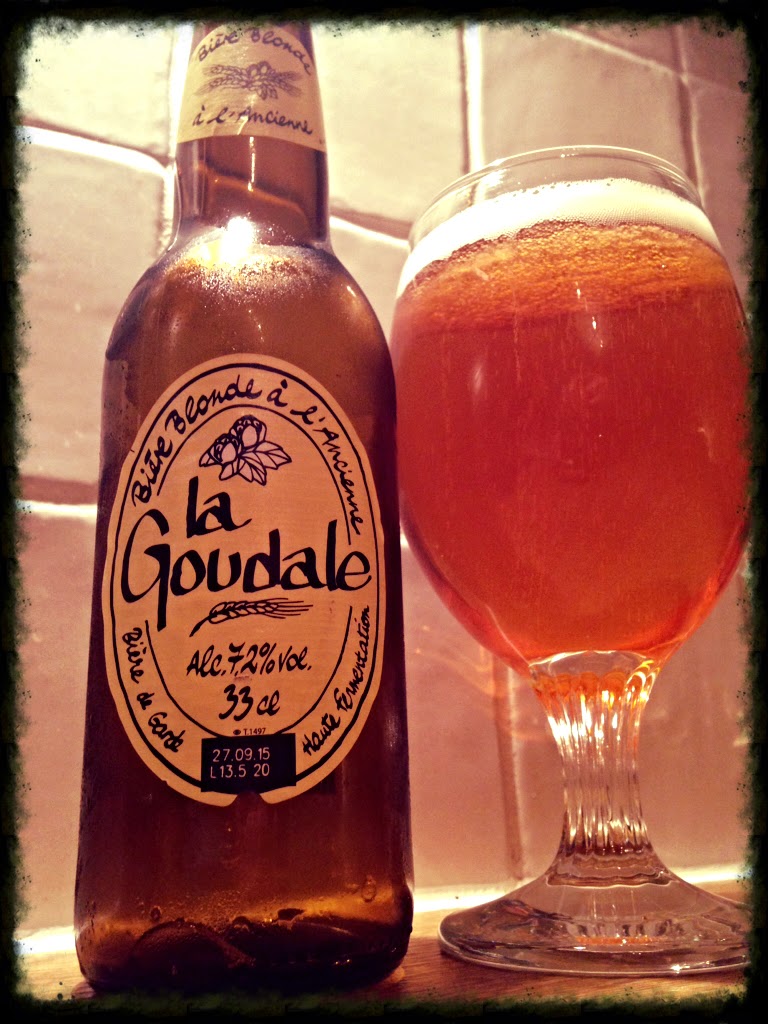
La Goudale (7.2%) - Brasserie de Gayant, Nord-Pas-De-Calais Region, France

I nabbed this beer (along with a trolley-load of others) from a French supermarket on the way to Belgium a few months ago, and after trying a few from this part of the world it's become clear that there's one prevalent style to have emerged from France and that's the farmhouse ale, or "keeping beer". Farmhouse-style being free-style in nature, though, means it's not necessarily predictable as we're about to find out.


La Goudale describes itself on the label as a traditional blonde beer of "high fermentation". What it means by that is that it's brewed in the style of an ale rather than a continental lager (i.e. with top-fermenting yeasts), which brings me to the name of the beer. "Goudale", as it explains on the label, was how the people of 14th century France would describe "good beer". In other words, "goudale" is a corruption of "good ale". And as if looking across the channel towards Blighty for a term to describe decent beer wasn't a big enough compliment, they went one step further to take the English term and make a new word out of it that even we don't have by referring to people who sold the stuff as "goudaliers".

It's a simple yellow-coloured label with the name of the beer printed on it in a kind of calligraphy style font and two small motifs of some hops and barley.

The beer itself is a nice clear, golden-copper colour (not represented in the photographs, I must admit) topped with a smooth, white head with good retention and some superb lacing down the glass once you get round to sipping it down. Bubbling lively from the bottom (of the glass, that is), it almost looks like a slightly darker lager. Since both other French farmhouse ales I've tried have been cloudy with sediment suspended in the glass, I was surprised to see this one pour clear. In this case, they must have decided to filter it.


On the nose it’s very, very gentle. There was something sweet lurking in there with the faintest hint of something herbal, but nothing concrete I could put my finger on. 

In the flavour, though, I wasn't disappointed. The first thing that came to mind once I'd had a sip was that it tasted different from the other ales I'd had from the same style (which isn't that unusual, given that it's a bit of an "anything goes" style, although you normally get similarities across the board).

My second impression came after a few seconds when, out of nowhere, the flavour developed into something else. Starting off fairly nondescript like the aroma, a bit of a malty sweetness going on with a slight herbal influence, you're suddenly faced with a wave of bready malts and honey and some stone fruits, along with some spicy hops and some Belgian-tasting clove flavours too. This then washes down when you swallow, allowing the 7.2% abv to warm your throat on the way down.
This lively wash of flavours makes it hard to pin down exactly what’s going on with the flavour, but what I can be sure of is a total absence of the mustiness I've experienced in other French keeping beers. Not that that's necessarily a bad thing.


After tasting the beer, with a helping hand from the effects of retro-nasal olfaction, you actually get more from the aroma when you go back to it. This time you can pick out more stone fruits, even some apple in there, and the bready aromas are complemented by some more hoppy, spicy and floral ones.

It’s medium-bodied with moderate carbonation, leaving a smooth mouthfeel overall, not leaving the musty dryness that, again, would normally come with a French keeping beer.

In fact, La Goudale seems so clean on every level that I was left to wonder just how "traditional" it was, as it claims to be on the label.

Saying that, it has a few surprises in store with a flavour that waits until it's washing around comfortably in your mouth before showing what it's capable of. And, even at a respectable 7.2%, it remains very drinkable.


Appearance 4/5
Aroma 3/5
Flavour 3/5
Mouthfeel 3.5/5

Beer Belly's rating: 7/10

Brewery details
Website: www.brasseurs-gayant.com  
Twitter: @brasseursgayant

Wednesday, 9 July 2014

L'Escampette (6%) - Brasserie Forest, Nord-Pas-De-Calais Region, France

As the first review on this blog for a beer to hail from outside the British Isles, it might come as a surprise that rather than opting for somewhere in central Europe or North America, which would seem like the most obvious choices, I've in fact gone for France, a country otherwise known for specialising in the production of alcoholic grape juice.

Picked up in a Carrefour supermarket near Calais on a recent trip across the channel, L'Escampette is an example of the one and only beer style originating in France, known as bière de garde (or "keeping beer"), typical of the region of Nord-Pas-De-Calais and traditionally brewed in farmhouses throughout the dark and cold winter months. This would not only allow consistent and quality results by keeping the beer cool, but also avoid any wild yeasts infiltrating the brews during the summer. These days, these French farmhouse-style ales are brewed all year round and are fairly open to interpretation, in true rustic spirit.

L'Escampette, brewed since 2001 in Monceau St Waast, comes in a charming 33ml bottle in a curvy shape resembling that of roof gables on the buildings in Belgium, which happens to be just down the road from this part of France. It's not clear what the significance of the blue-eyed, blonde haired woman holding the three litre-glasses of beer is, but for the sake of the style let's say she's serving up some sweaty fermiers who have returned from a long day out on the fields.

The beer pours a golden amber colour with a small amount of sediment suspended in the glass owing to the fact that it's unfiltered. A nice foam settles on top, lacing the glass on its way down. 

The aroma is fairly gentle: some stone fruits with tropical hints present a sweet aroma with otherwise earthy and musty undertones. A slightly rotten apple can be detected in there as well.

Things liven up when you take a swig, a strong malty core suddenly coming to the fore with the same sweet fruity and earthy, herbal flavours emerging around it and becoming much more pronounced, with a faint spiciness presenting itself as well. Again, it's got that slightly musty, funky quality to it that's typical of French farmhouse ales.

It's lightly carbonated, full-bodied and dry with a heavy, long-lasting, musty aftertaste. The 6% abv presents itself in the form of a pleasant warming sensation.

L'Escampette is definitely an intriguing one, if only for the style it represents. Complex overall, with contradicting qualities of fruitiness followed by mustiness, it's got bags of rustic character. Despite the musty qualities, though, it's still very quenching, and I imagine it to be a great end to a day out on the fields (not that I'd know what that feels like).


Appearance 4/5
Aroma 3/5
Flavour 3.5/5
Mouthfeel 3.5/5
Beer Belly's Overall Rating: 7/10


Thursday, 20 March 2014

Santa's Reserve (5.2%) - Ascot Ales, Surrey, England

You'd be forgiven for thinking that at the time of posting this, on the day of the Spring equinox, this is a late entry for a Christmas ale. But of the many different festive brews I sampled throughout the Christmas period (and I stocked up so well that I haven't even got through them all yet) this was one of the more unique ones I tried that was given to me as a well-received gift, and as a seasonal beer not everyone's heard of I thought I'd share it with you.


A little known fact about Santa is that when he isn't busy in his workshop he loves nothing more than to indulge in a bit of homebrewing, and so he's pictured on the bottle of Santa's Reserve kicking back with one of his ales as he relaxes by the fire. The same beer is served from a cask in local pubs under the name of Winter Reserve.

It pours a dark, murky mahogany colour with an enormous and lively cappuccino coloured head that settles into a puffy, snowy cushion. You'll also notice some sediment at the bottom of the bottle, an extra pinch of yeast that produces a natural effervescence and keeps the brew alive from Santa's cask all the way to your mouth. This traditional method is a good indicator that you're drinking something of quality, that a small team of elves have put their blood, sweat and tears into.
Surrey within England

On the nose you get all the things you want from a Christmas ale: chocolatey, fruity and spicy aromas, all smelling natural and not artificial. With a touch of ginger and cinnamon in there, the spicy aromas are the most dominant.

The sweet chocolate malts come through more noticeably in the taste, but spicy, bitter hops prevail, with peppery and herbal flavours leaving a dry finish on the pallet. The full body leaves you with a nice, Christmassy warming sensation.  

While you might expect richer, chocolatier and fruitier flavours from a Christmas ale, Ascot Ales seem to have focused on bringing out the festive spices instead, producing a beer that's probably more bitter and hoppy than you might expect. Whether it's to your taste or not, though, you know you're drinking something of quality, brewed in small batches and handcrafted (with the help of a few elves).


Beer Belly's Rating:
Appearance 5/5
Aroma 3/5
Flavour 3/5
Mouthfeel 4/5
Summary 7.5/10


Thursday, 12 September 2013

Boondoggle (5%) - Ringwood Brewery, Hampshire, England


"Down here in the New Forest," it says on the back of the label, "we call carefree, lazy days, 'Boondoggle days'". This beer from Ringwood brewery, situated just outside the New Forest in Hampshire has been conceived as just the excuse you need for a pint on those lazy, summer days (if an excuse is really what you needed). The free-living wild boar pictured chilling out on the bottle's golden-yellow label says it all.

Described as a blonde ale on the label, Boondoggle is probably darker than you'd expect. The colour of the label implies it will be a pilsneresque sparkly gold, but in reality what pours out is the kind of amber you're used to seeing from, well, an amber ale. The head is bright white, a little on the thin side and doesn't take long to disperse into a patchy layer with islands of small bubbles.

When I popped off the cap I was struck by the yeasty, bready aroma but once the first waft was out of the way mainly delicate hoppy, floral and herbal notes remained thanks to the First Gold and Fuggles hops. A combination of the yeast and citrus fruits with hints of marmalade remind me of a lemon drizzle cake; a combination I'm happy to try by all means.

Hampshire within England
Take a swig and you're presented with a thick and chewy liquid, smooth all but for the spicy tingling sensation on the back of the tongue which leaves a mildly dry finish, creating a moreish texture overall. The fruity flavour alternates nicely between sweet malts and bitter citrus, the bitter aftertaste becoming sweet and nutty when you exhale. It's interesting yet easy-going and certainly a fine candidate for a lazy summer session. Act with caution on a particularly warm day though, as the 5% ABV will make its presence felt!


Beer Belly's Rating:
Appearance 4/5
Aroma 3/5
Mouthfeel 4/5
Flavour 4/5
Total 7.5/10 

Have you tried Boondoggle from Ringwood Brewery? What do you think? Leave your comments and rating below!