Brews by Country

Showing posts with label clove. Show all posts

Monday, 23 April 2018

Palpita (5.8%) - Cervezas Yakka, Murcia, Spain


In a country where the mention of beer normally calls to mind the mass-produced lager of that region, a quiet rebellion is taking place. As beer guzzlers nationwide develop a growing curiosity for brews with depth and flavour, craft brewers drawing their inspiration from further afield are springing up and catering for ever-inquisitive palates.

Palpita, a name which refers to the beat of a heart, pours an inviting, slightly hazy golden straw colour with an active carbonation that sees bubbles rising quickly to the surface.
Murcia within Spain

While the aroma was subtle on the nose at first, as my brew neared room temperature those classic blonde ale aromas of sweet bready malts and subtle light fruits came to the fore.

The flavour certainly didn't hold back though, gushing forth with a sweet, bready malt backing underpinning spicy clove, fruity hints and a touch of hop bitterness, creating a pleasantly intense and complex character that got my ticker fluttering like a Murcian flag in the breeze.

Full-bodied, thick and juicy, this is a brew that's easy to get your chops around, rounded off with a crisp, medium-dry toasted finish and a pleasing lingering warmth from the 5.8% ABV to warm the cockles of your heart. 

This Belgian-inspired Murcian blonde ale is modest yet packed with character, and can be enjoyed as a chilled, refreshing quencher or savoured as a slow-sipper to your palpitating heart's content. 

Appearance 4/5
Aroma 3/5
Flavour 4/5
Mouthfeel 4/5
Overall 7.5/10

🍻Cheers us on Facebook🍻


Palpita on TV:


Palpita online:
Website here
Facebook page here

Where to buy:
1,70€ on Cervezas Diferentes

Friday, 23 June 2017

The Blonde, The Blanche and The Ambrée: The Grimbergen range.

Few things bring me more joy than a nice bottle of beer, but if there's one thing that does, it's three bottles:


These bad boys and the chalice they were destined for came into my possession long ago when everyone in the northern hemisphere was in the throes of winter, and yet it's taken me until now to sip my way through the trio, starting with the lightest in a temperate April and ending with the darkest in the unrelenting heat of a Murcian June - perhaps not the most logical sequence as far as matching beer with season goes, although the colours did follow the same pattern as my ever toasting skin. 


Obernai's former region of Alsace
within France. (Part of the new
Grand Est region since 2016)
Grimbergen beer has been going, in one way or another, since the dark Medieval days of 1128 - although since starting its life as a monk-brewed abbey beer in Belgium, the periodic accident and conflict-driven destruction of the abbey followed by several commercial takeovers in more recent times means the beer, now brewed partly in Belgium and partly in France, probably differs somewhat from what the Norbertine monks of Grimbergen used to get sozzled on with their guests. Indeed, the Belgian and French breweries even brew completely separate varieties (those coming from Belgium being mainly Blond, Dubbel and Tripel), meaning that the beers in my box were sure to have come from the Kronenbourg brewery in Obernai, France. Just call me the Beer Detective.

But no beer is complete without a story, and as the monks' use of the phoenix would imply, rebirth is a significant aspect of this beer's identity - so if the legend at the very least has managed to be kept alive over the course of almost a whopping nine centuries, then all the better. 

Onto the beers:

Blonde 6.7%

She pours a perfect golden amber with a dense, bright fluffy head and, as with all of Grimbergen's beers, looks particularly fine in the beer's own purpose-made chalice. 
It had been a long time since I'd tasted the delights of a Belgian-style ale and the distinctly Belgian whiff of spicy clove that wafted up from my chalice's bowl was a stark reminder of where this brew was born. Along with these spicy notes there were plenty of hints of toffee and caramel malt on the nose giving me a clue as to what was to come. 
After a gulp or two, malty depth came through peppered with spicy clove, broken up ever so slightly by a hint of bitter citrus, followed by a floral, soapy aftertaste. 
For its high ABV it goes down nice and easily, and since it's got plenty of depth you can afford to sup on it chilled without fear of compromising on flavour.

Blanche 6%

The Blanche pours an opaque pale straw colour with a small head that fizzled out quicker than I could snap it.
There's plenty going on on the nose with fragrant, perfumey and floral aromas seasoned with herbal notes and spicy clove, overall making for a fresh and complex first impression.
The fresh flavours of zesty citrus fruits and a strong presence of coriander and clove come through after a sip, but it soon becomes clear that where it exceeds in flavour it lacks in body and depth, almost a diluted version of what it could be.
Rather than a sipper to savour I'd call this an introduction to the style to be knocked back.


Double-Ambrée 6.5%

The darkest of the three, this pours a dark mahogany with a thin beige head.
I picked up the aromas of dark stone fruits and berries, even if they were a bit hesitant in coming forward.
The flavour doesn't disappoint, with rich, fruity woodland berries backed by sweet caramel, a hint of treacle and a dash of bitter coffee - a sweet, fruity experience with the welcome addition of an added 6.5% alcoholic warmth. 
As the aroma hadn't been so forthcoming I was pleasantly surprised by the taste. A touch more body could have brought more depth to the flavours, but overall of the three in the set, the double-ambrée is the brew I'm fondest of. Santé!

Like Beer There Drunk That on Facebook

Grimbergen's Website
Grimbergen on Facebook

Wednesday, 8 April 2015

N’Ice Chouffe (10%) - Brasserie d’Achouffe, Luxembourg Province, Belgium


With the spring months well under way here in Blighty, it seems distateful, nay, downright perverse to post a detailed description of my experience with a Christmas beer. But experiences are to be shared, and share this I will.

The label shows a wintry scene with two of the brewery's trademark gnomes warming up by a camp fire outside in the snow, carrying hops and barley. They seem ready to sling the hops and barley into the fire: arguably not the best use for two key ingredients to the best beverage in the world, but I suppose even Chouffe gnomes will do what they can to stay warm. Then again, they could equally be fighting to rescue the grain and hop plants from the flames. Yes, valiant gnomes, we'll stick with that version of events.

N'Ice Chouffe pours pitch black, allowing some shades of deep ruby red to glow through when up against the light. The brewery's own curvaceous and reflective tulip glass does the beer's appearance full justice, showing off the lively carbonation that rises quickly from the bulbous black body to form the superb, bubbling off-white head that pushes up past the base of the lip.

The glass trapping the aroma magnificently, at first whiff my impression is that it smells unmistakeably Belgian with herbal clove aromas coming through. A rich chocolate and crystal malt backing brings out a toffee tinge alongside some forest fruits.

Things intensify by the camp fire with a super rich flavour of sweet brown "candi" sugar and lots of grassy, herbal notes all coming at you at once. The carbonation helps to cut through the intense sweetness, but for me doesn't go far enough to stop it from being too cloying. Finally, a big alcoholic burn reminds you what happens when a gnome gets his beard too close to a camp fire.

As a seasonal brew, N'Ice Chouffe leaves no doubt that it was conceived as a winter warmer (despite the reference to "ice" in the name). However, with such a burny and intense character it doesn't sit so N'Icely on the palate.

Appearance 4/5
Aroma 3.5/5
Flavour 3/5
Mouthfeel 2/5

Overall rating 6.5/10

Tuesday, 30 September 2014

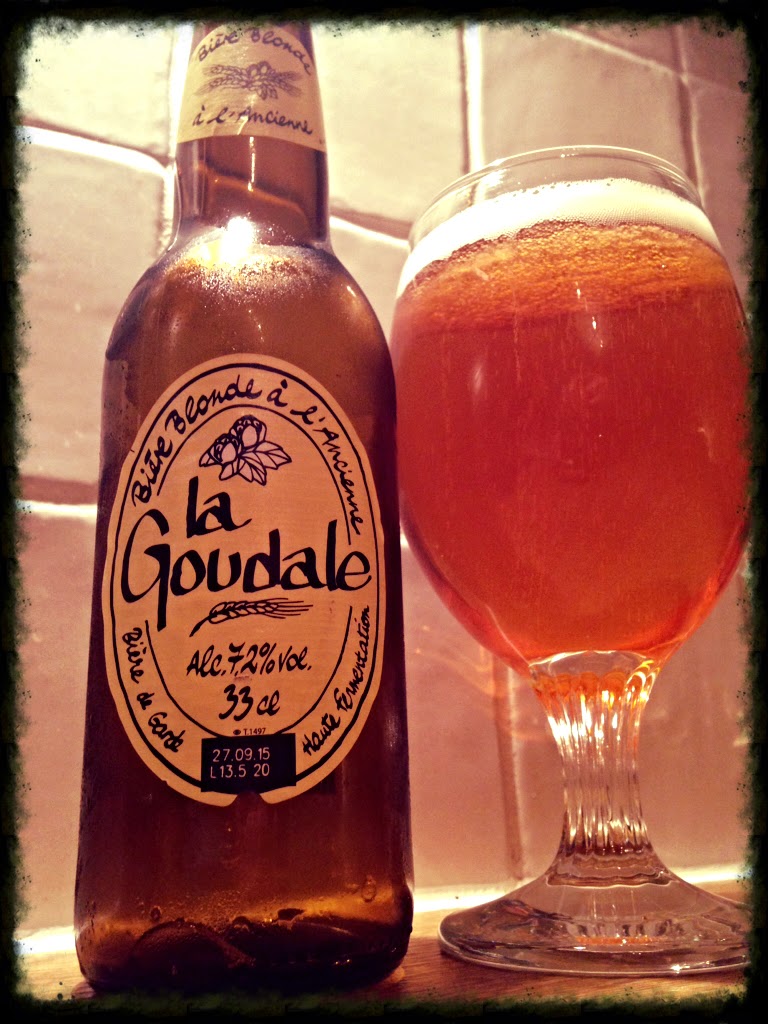
La Goudale (7.2%) - Brasserie de Gayant, Nord-Pas-De-Calais Region, France

I nabbed this beer (along with a trolley-load of others) from a French supermarket on the way to Belgium a few months ago, and after trying a few from this part of the world it's become clear that there's one prevalent style to have emerged from France and that's the farmhouse ale, or "keeping beer". Farmhouse-style being free-style in nature, though, means it's not necessarily predictable as we're about to find out.


La Goudale describes itself on the label as a traditional blonde beer of "high fermentation". What it means by that is that it's brewed in the style of an ale rather than a continental lager (i.e. with top-fermenting yeasts), which brings me to the name of the beer. "Goudale", as it explains on the label, was how the people of 14th century France would describe "good beer". In other words, "goudale" is a corruption of "good ale". And as if looking across the channel towards Blighty for a term to describe decent beer wasn't a big enough compliment, they went one step further to take the English term and make a new word out of it that even we don't have by referring to people who sold the stuff as "goudaliers".

It's a simple yellow-coloured label with the name of the beer printed on it in a kind of calligraphy style font and two small motifs of some hops and barley.

The beer itself is a nice clear, golden-copper colour (not represented in the photographs, I must admit) topped with a smooth, white head with good retention and some superb lacing down the glass once you get round to sipping it down. Bubbling lively from the bottom (of the glass, that is), it almost looks like a slightly darker lager. Since both other French farmhouse ales I've tried have been cloudy with sediment suspended in the glass, I was surprised to see this one pour clear. In this case, they must have decided to filter it.


On the nose it’s very, very gentle. There was something sweet lurking in there with the faintest hint of something herbal, but nothing concrete I could put my finger on. 

In the flavour, though, I wasn't disappointed. The first thing that came to mind once I'd had a sip was that it tasted different from the other ales I'd had from the same style (which isn't that unusual, given that it's a bit of an "anything goes" style, although you normally get similarities across the board).

My second impression came after a few seconds when, out of nowhere, the flavour developed into something else. Starting off fairly nondescript like the aroma, a bit of a malty sweetness going on with a slight herbal influence, you're suddenly faced with a wave of bready malts and honey and some stone fruits, along with some spicy hops and some Belgian-tasting clove flavours too. This then washes down when you swallow, allowing the 7.2% abv to warm your throat on the way down.
This lively wash of flavours makes it hard to pin down exactly what’s going on with the flavour, but what I can be sure of is a total absence of the mustiness I've experienced in other French keeping beers. Not that that's necessarily a bad thing.


After tasting the beer, with a helping hand from the effects of retro-nasal olfaction, you actually get more from the aroma when you go back to it. This time you can pick out more stone fruits, even some apple in there, and the bready aromas are complemented by some more hoppy, spicy and floral ones.

It’s medium-bodied with moderate carbonation, leaving a smooth mouthfeel overall, not leaving the musty dryness that, again, would normally come with a French keeping beer.

In fact, La Goudale seems so clean on every level that I was left to wonder just how "traditional" it was, as it claims to be on the label.

Saying that, it has a few surprises in store with a flavour that waits until it's washing around comfortably in your mouth before showing what it's capable of. And, even at a respectable 7.2%, it remains very drinkable.


Appearance 4/5
Aroma 3/5
Flavour 3/5
Mouthfeel 3.5/5

Beer Belly's rating: 7/10

Brewery details
Website: www.brasseurs-gayant.com  
Twitter: @brasseursgayant