Brews by Country

Showing posts with label copper. Show all posts

Tuesday, 2 December 2014

English Bay Pale Ale (5%) - Granville Island Brewing, Vancouver, Canada


English Bay, Vancouver. A charming part of the city with sea, sandy beaches, shiny skyscrapers and tree-covered, snow-capped mountains all in one view. For an English Bay, it's anything but English.

My girlfriend and I went on many walks there during our trip back in April, and if I could take a piece of it back to Blighty with me in the form of a beer then all the better (wrapping it up snugly for its ten-hour flight home, of course).
 
I grabbed this bottle at Granville Island Brewing itself, not far from English Bay. In a 341ml bottle (a measurement this beer-swilling Brit hadn’t come across before), the label features the brewery’s logo on it with their slogan “It’s good to be here”. I don’t know where they’re referring to, but if it’s anywhere in the general Vancouver area then I can’t help but agree.

The beer poured a darker amber than I’d expected from a pale ale, with shades of copper up against certain light. As the label suggests, the aroma is very much on the malty side of things with sweet caramel and toffee aromas coming through – “West Coast character” as they call it – and hints of treacle and chocolate. Hops provide some fruity berries and earthy characteristics. A decent waft of a very pleasant aroma on the whole and one I was very keen to dive into.


With an aroma that reminded me more of an English bitter, the flavour had some surprises in store. Mild as the label suggests, with caramels and some fruity woodland berries coming through again, but with a tasty nutty undercurrent that lingered on in the aftertaste. The flavours began to emerge nicely as it approached room temperature, but remained modestly mild rather than jumping out at me in typical North American fashion. It's nicely carbonated and smooth, but not full enough in body.


Overall I was pleasantly surprised by English Bay Pale Ale. Granville Island Brewing have come up with something complex, unique and very drinkable, but this beer might leave you with the feeling that its thin body doesn't let you get the most out of its character, compromising on some otherwise very enjoyable flavours.

Appearance 4/5
Aroma 4/5
Flavour 3.5/5
Mouthfeel 2/5

Beer Belly’s rating: 7/10

Tuesday, 30 September 2014

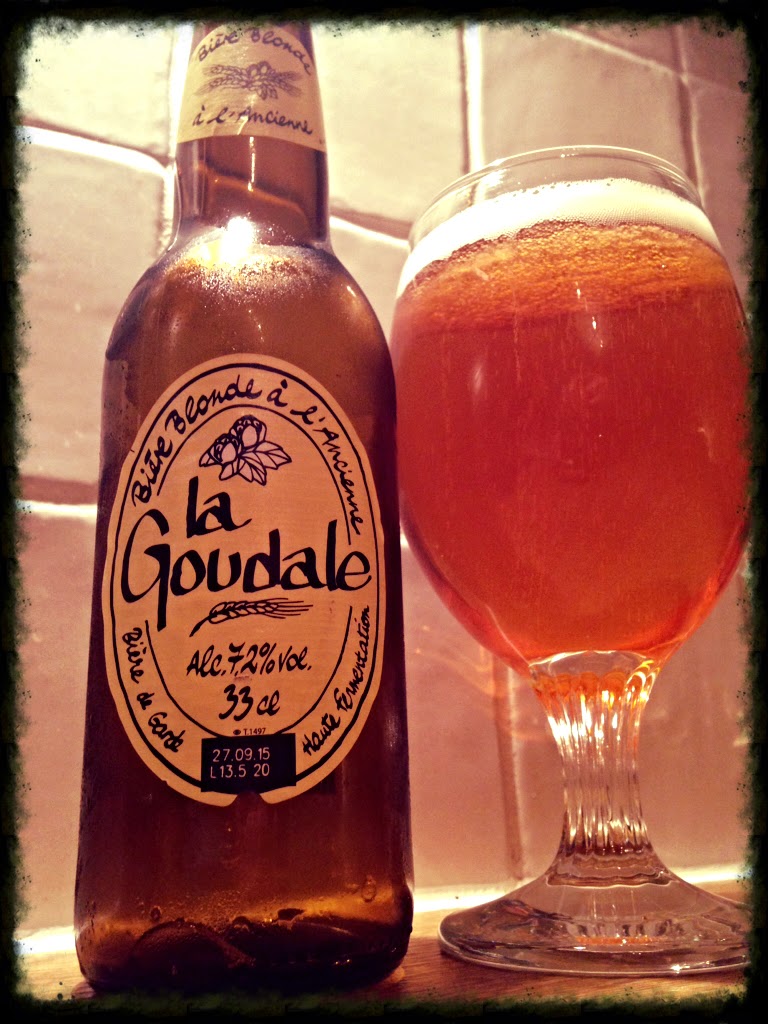
La Goudale (7.2%) - Brasserie de Gayant, Nord-Pas-De-Calais Region, France

I nabbed this beer (along with a trolley-load of others) from a French supermarket on the way to Belgium a few months ago, and after trying a few from this part of the world it's become clear that there's one prevalent style to have emerged from France and that's the farmhouse ale, or "keeping beer". Farmhouse-style being free-style in nature, though, means it's not necessarily predictable as we're about to find out.


La Goudale describes itself on the label as a traditional blonde beer of "high fermentation". What it means by that is that it's brewed in the style of an ale rather than a continental lager (i.e. with top-fermenting yeasts), which brings me to the name of the beer. "Goudale", as it explains on the label, was how the people of 14th century France would describe "good beer". In other words, "goudale" is a corruption of "good ale". And as if looking across the channel towards Blighty for a term to describe decent beer wasn't a big enough compliment, they went one step further to take the English term and make a new word out of it that even we don't have by referring to people who sold the stuff as "goudaliers".

It's a simple yellow-coloured label with the name of the beer printed on it in a kind of calligraphy style font and two small motifs of some hops and barley.

The beer itself is a nice clear, golden-copper colour (not represented in the photographs, I must admit) topped with a smooth, white head with good retention and some superb lacing down the glass once you get round to sipping it down. Bubbling lively from the bottom (of the glass, that is), it almost looks like a slightly darker lager. Since both other French farmhouse ales I've tried have been cloudy with sediment suspended in the glass, I was surprised to see this one pour clear. In this case, they must have decided to filter it.


On the nose it’s very, very gentle. There was something sweet lurking in there with the faintest hint of something herbal, but nothing concrete I could put my finger on. 

In the flavour, though, I wasn't disappointed. The first thing that came to mind once I'd had a sip was that it tasted different from the other ales I'd had from the same style (which isn't that unusual, given that it's a bit of an "anything goes" style, although you normally get similarities across the board).

My second impression came after a few seconds when, out of nowhere, the flavour developed into something else. Starting off fairly nondescript like the aroma, a bit of a malty sweetness going on with a slight herbal influence, you're suddenly faced with a wave of bready malts and honey and some stone fruits, along with some spicy hops and some Belgian-tasting clove flavours too. This then washes down when you swallow, allowing the 7.2% abv to warm your throat on the way down.
This lively wash of flavours makes it hard to pin down exactly what’s going on with the flavour, but what I can be sure of is a total absence of the mustiness I've experienced in other French keeping beers. Not that that's necessarily a bad thing.


After tasting the beer, with a helping hand from the effects of retro-nasal olfaction, you actually get more from the aroma when you go back to it. This time you can pick out more stone fruits, even some apple in there, and the bready aromas are complemented by some more hoppy, spicy and floral ones.

It’s medium-bodied with moderate carbonation, leaving a smooth mouthfeel overall, not leaving the musty dryness that, again, would normally come with a French keeping beer.

In fact, La Goudale seems so clean on every level that I was left to wonder just how "traditional" it was, as it claims to be on the label.

Saying that, it has a few surprises in store with a flavour that waits until it's washing around comfortably in your mouth before showing what it's capable of. And, even at a respectable 7.2%, it remains very drinkable.


Appearance 4/5
Aroma 3/5
Flavour 3/5
Mouthfeel 3.5/5

Beer Belly's rating: 7/10

Brewery details
Website: www.brasseurs-gayant.com  
Twitter: @brasseursgayant

Monday, 25 August 2014

Chimay Brune (7%) - Chimay Brewery, Hainaut Province, Belgium

It was tough work picking out a brew from such a tempting selection of Belgian beers that I hauled back from my recent trip to Belgium, but after 20 minutes of gawping indecisively at various bottles and studying the labels one by one, I finally opted to explore my inner monk with this exciting number.

Chimay Brune as it's called on the bottle (but Chimay Rouge seemingly everywhere else) is a 7% strong Belgian Trappist double from Chimay Brewery in the Hainaut province of Belgium. The brewery itself is located at the Scourmont Abbey where the beer is brewed by monks according to strict Trappist criteria, making it one of only 10 authentic Trappist breweries in the world. These pious souls spend their days happily brewing away, selling beer not for profit but to just about cover their own living expenses, giving the rest away to charity. I'll be honest that I had no idea about this when I shoved this one into my shopping basket, but the moment I discovered that the bottle I held before me was a product of this now rare tradition, my excitement became a lot more uncontainable. I also briefly considered becoming a monk.

In case you're wondering what makes it a double or dubbel, this comes from a traditional labelling system when crosses were used to indicate a particular brew's strength, "XX" (double) coming logically between X (single) and XXX (triple), a tradition that's stuck to this day for some. With this supposedly middle-strength beer coming in at 7%, it's clear those quiet Trappist monks still know how to live it up. 

Chimay Brune comes in a charming little 33ml bottle with “Abbaye de Scourmont” embossed on it. The label is quite simple, showing a golden shield with the Chimay logo sitting under two fleurs-de-lis. It pours a stunning ruby-copper colour almost matching the label and is topped off with a decent sized, creamy off-white head. Of course, with an appreciation for the real deal the monks don't bother themselves with pasteurisation, conditioning the beer naturally in the bottle. As far as appearances go, it’s nothing short of drool-inducingly gorgeous. 
The aroma is slight but immediately distinctive, with sweet, wheaty, fruity, apricot aromas coming out, fairly unique from other Belgian beers and worlds apart from any British beers.


The flavour carries on in a similar vein with sweet and wheaty flavours along with some dried apricots. The addition of earthy and peppery hops cuts through a sweet and malty undercurrent, and carries much more of a punch than expected. The flavours are swirled around by the lively carbonation before settling down to leave you with a gentle, fruity aftertaste that gradually fades with a warming finish. Chimay rushes in there, sweeps you off your feet and then elegantly puts you down again like some kind of holy beery revelation.


For a brew conceived by some modest Trappist monks, Chimay Brune has so much going on not just in the flavour but in the mouthfeel and texture as well. It has a gentle aroma, a flavour that erupts in your mouth before calming down again, and is every bit as sexy to look at as the Notre-Dame de Scourmont herself.

Appearance 5/5
Aroma 4/5
Flavour 4/5
Mouthfeel 4/5
Beer Belly's Rating 8.5/10

Brewery details
Website: http://www.chimay.com
Twitter: @ChimayUSA (don't ask why)

Thursday, 7 November 2013

Late Red (4.5%) - Shepherd Neame Brewery, Kent, England


We're about to leave the autumn months behind so I had to grab this one while it was still on the shelves. Late Red from "Britain's oldest brewer", Shepherd Neame in Faversham, Kent, is a seasonal autumn ale available from September to November. Full of auburn and copper colours on the label, it pictures hops dangling in the late autumn sunset, hinting at what flavours might lie inside.

The clear, characteristically Shepherd Neame-shaped bottle allows a good view of the wonderfully deep amber-ruby liquid inside, although we all know what that could mean: light strike.

It looks just as good in the glass, although the fizzy, off-white head doesn't amount to much and quickly fizzles into nothing.

Nosing about for some aroma, I pick up on berries, something roasted and a hint of toffee along with some hoppy citrus and a slightly herbal aroma from the Cascade and local East Kent Goldings hops, although the aromas are faint and hard to pin down.

Kent within England
Once I dive in the flavours become clearer, with a bittersweet mouthful of sweet toasted malts swishing around with herbal, floral and peppery flavours finishing with a dry and bitter aftertaste. Although complex in nature, I can't help feeling the flavours are a bit too diluted and accompanied by an unpleasant taste of soap (and that's not my fault - I gave the glass a good rinsing).

Late Red started off promising but the more it warmed up, the less I got on with it. Instead of bringing out the character, which is what a warmer temperature should do, it made me wonder if among those crisp autumn leaves a few had been blown out of a gutter.

The crisp, toasted, floral nature of Late Red makes it impressively fitting for this time of year, but if I pick one up again it will have to be chilled enough to mask some of the less welcome flavours.
   
Beer Belly's rating:
Appearance 3/5
Aroma 3/5
Flavour 2/5
Mouthfeel 2/5
Total 5/10